
Keywords
Latin America
Periphery
capitalism
underdevelopment
Abstract
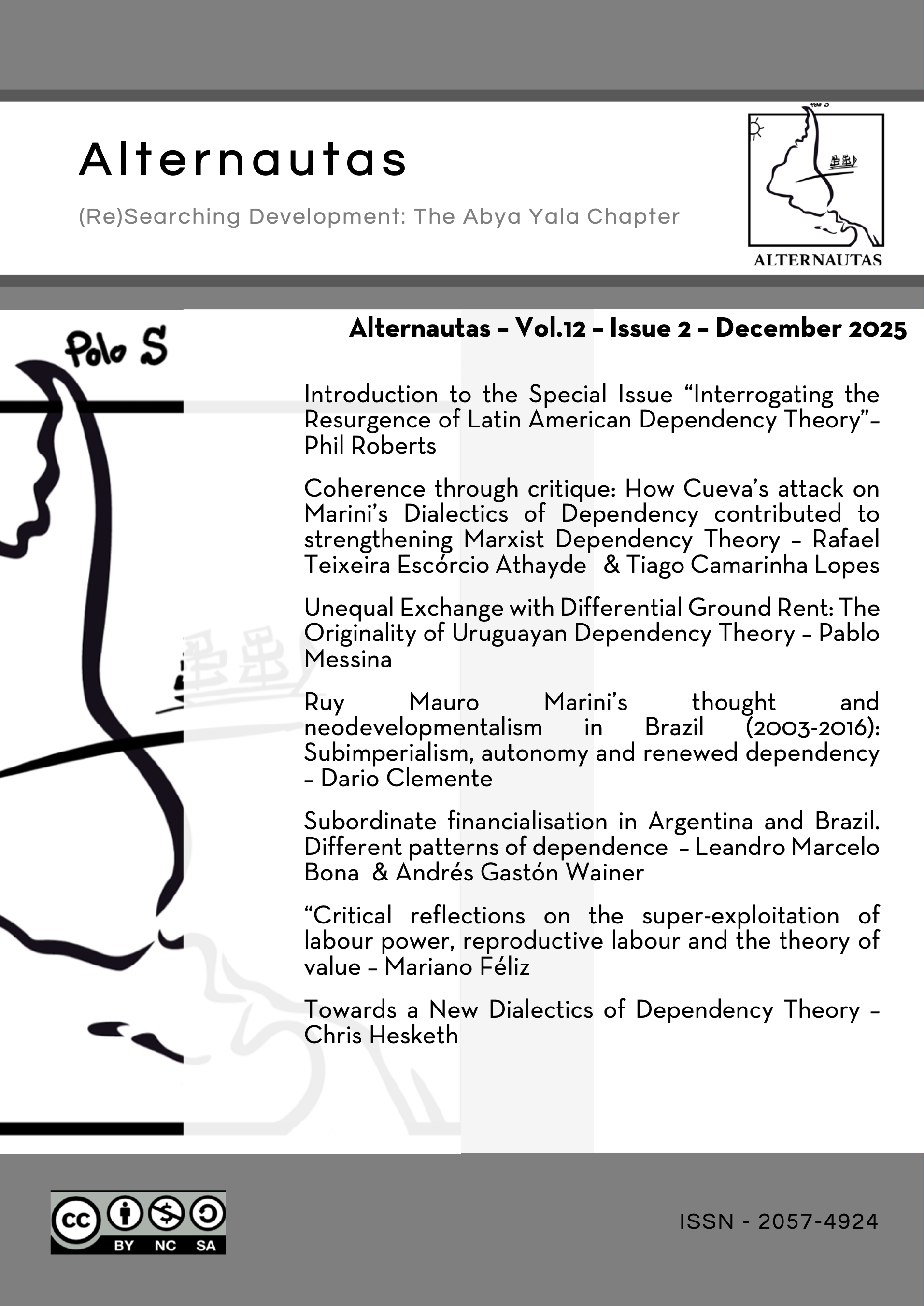
As 2025 draws to a close, we are witnessing a fundamental transformation of the global economy and political order established in the 1970s and '80s. The rise of China to become by some measures the largest economy in the world, and the formation of the BRICS as an influential grouping of non-Western states, shows a profound shift in the geography of capital accumulation since the 1980s. But the growing significance of China, India, and the constellation of other high-growth economies, has not led to the worldwide convergence promised by advocates of neoliberal globalization. Rather, the emerging world order once again raises the prospect of transformation without convergence that is fundamental to Dependency Theory. Viewed from Latin America, the parallels between the current era and the original formative period of Dependency Theory are striking. Latin America faces de-industrialization, a return to 'extractivism' based on natural resource exports, combined with persistent poverty and rising inequality, mirroring its position in the early to mid-20th century. The political, social, and economic transformations outlined above have coincided with a renewed interest in Latin American Dependency Theory, both within the continent and beyond. This Special Issue of Alternautas explores the ongoing significance of this 'view from the periphery' in terms of its historical roots and its novel contemporary transformations.
References
Amsden, A. H. (1979). Taiwan's economic history: a case of etatisme and a challenge to dependency theory. Modern China, 5(3), 341-379.
Alami, I., Alves, C., Bonizzi, B., Kaltenbrunner, A., Koddenbrock, K., Kvangraven, I., & Powell, J. (2022). International financial subordination: a critical research agenda. Review of International Political Economy, 1-27.
Amin, S. (1972). Underdevelopment and dependence in Black Africa—origins and contemporary forms. The Journal of Modern African Studies, 10(4), 503-524.
Antunes de Oliveira, F. (2019). The rise of the Latin American far-right explained: dependency theory meets uneven and combined development. Globalizations, 16(7), 1145-1164.
Antunes de Oliveira, F. (2021). Who are the super-exploited? Gender, race, and the intersectional potentialities of dependency theory. Dependent capitalisms in contemporary Latin America and Europe, 101-128.
Antunes de Oliveira, F. (2024). Dependency and Crisis in Brazil and Argentina: A Critique of Market and State Utopias. Pittsburgh: University of Pittsburgh Press
Bagchi, A. K. (1982). The political economy of underdevelopment. Cambridge University Press.
Bambirra, V. (1978). Teoría de la dependencia: una anticrítica (Vol. 68). Mexico: Ediciones Era.
Bond, P. (2015). Sub-imperialism as lubricant of neoliberalism: South African ‘deputy sheriff' duty within BRICS. In Rising powers and the future of global governance (pp. 69-88). Routledge.
Bond, P. (2016). BRICS banking and the debate over sub-imperialism, Third World Quarterly, 37:4, 611-629
Booth, D. (1985) ‘Marxism and Development Sociology: Interpreting the Impasse’, World Development 13(7): 761–87.
Brenner, R. (1977). The Origins of Capitalist Development: A Critique of Neo-Smithian Marxism. New Left Review London, (104), 25-92.
Cueva, A., & Calvo, P. (1974). Problemas y perspectivas de la teoría de la dependencia. Revista Economía, (62), 9-41.
Cardoso, F. H. (1977). The consumption of dependency theory in the United States. Latin American Research Review, 12(3), 7-24.
Cardoso, F. H., & Faletto, E. (2024). Dependency and development in Latin America. University of California Press.
Carmody, P. (2020). Dependence not debt-trap diplomacy. Area development and policy, 5(1), 23-31.
Fischer, A. M. (2015). The end of peripheries? On the enduring relevance of structuralism for understanding contemporary global development. Development and change, 46(4), 700-732.
Frank, A. G. (1967). Capitalism and underdevelopment in Latin America (Vol. 93). NYU Press.
Galeano, E. (1997). Open veins of Latin America: Five centuries of the pillage of a continent. NYU Press.
Giraudo, M. E. (2020). Dependent development in South America: China and the soybean nexus. Journal of Agrarian Change, 20(1), 60-78.
Frank, A.G. (1969) Latin America: Underdevelopment or Revolution. London: Monthly Review Press.
Jenkins, R. (2012). Latin America and China—a new dependency?. Third World Quarterly, 33(7), 1337-1358.
Katz, C. (2022a). Dependency theory after fifty years: The continuing relevance of Latin American critical thought (Vol. 207). Brill.
Katz, C. (2022b). The cycle of dependency 50 years later. Latin American Perspectives, 49(2), 8-23.
Kay, C. (1989). Latin American theories of development and underdevelopment. Routledge.
Kvangraven, I. H. (2021). Beyond the stereotype: Restating the relevance of the dependency research programme. Development and Change, 52(1), 76-112.
Lall, S. (1975). Is ‘dependence’ a useful concept in analysing underdevelopment?. World Development, 3(11-12), 799-810.
Lefebvre, H (1991). The Production of Space translated by D. Nicholson-Smith. Oxford: Blackwell.
Marini, R. M. (2022). The Dialectics of Dependency. NYU Press.
Marini, R. M. (1978). Las razones del neodesarrollismo (respuesta a FH Cardoso y J. Serra). Revista Mexicana de sociologia, 40, 57-106.
Osorio, J. (2022). Assessing a proposal for updating the Marxist theory of dependency. Latin American Perspectives, 49(1), 153-165.
Rodney, W. (2018). How europe underdeveloped africa. Verso Books.
Serra, J., & Cardoso, F. H. (1978). Las desventuras de la dialéctica de la dependencia. Revista mexicana de Sociología, 9-55.
Stallings, B. (2020). Dependency in the twenty-first century?: The political economy of China-Latin America relations. Cambridge University Press.
Svampa, M. (2021). Debates latinoamericanos: indianismo, desarrollo, dependencia y populismo. Edhasa.
Tavares, M. D. C. (1985). A retomada da hegemonia norte-americana. Brazilian Journal of Political Economy, 5(2), 157-167.
Taylor, I. (2016). Dependency redux: Why Africa is not rising. Review of African Political Economy, 43(147), 8-25.
Vigevani, T., & Cepaluni, G. (2012). Brazilian foreign policy in changing times: the quest for autonomy from Sarney to Lula. Lexington Books.
Villegas Plá, B. (2023). Dependency theory meets feminist economics: a research agenda. Third World Quarterly, 1-18.

This work is licensed under a Creative Commons Attribution-NonCommercial-ShareAlike 4.0 International License.
Copyright (c) 2025 Philip Roberts